Exploring Genesis Chapters 6-10: A Catholic Journey Through Judgment, Mercy, and Covenant
- David. EW

- Dec 11, 2025
- 14 min read
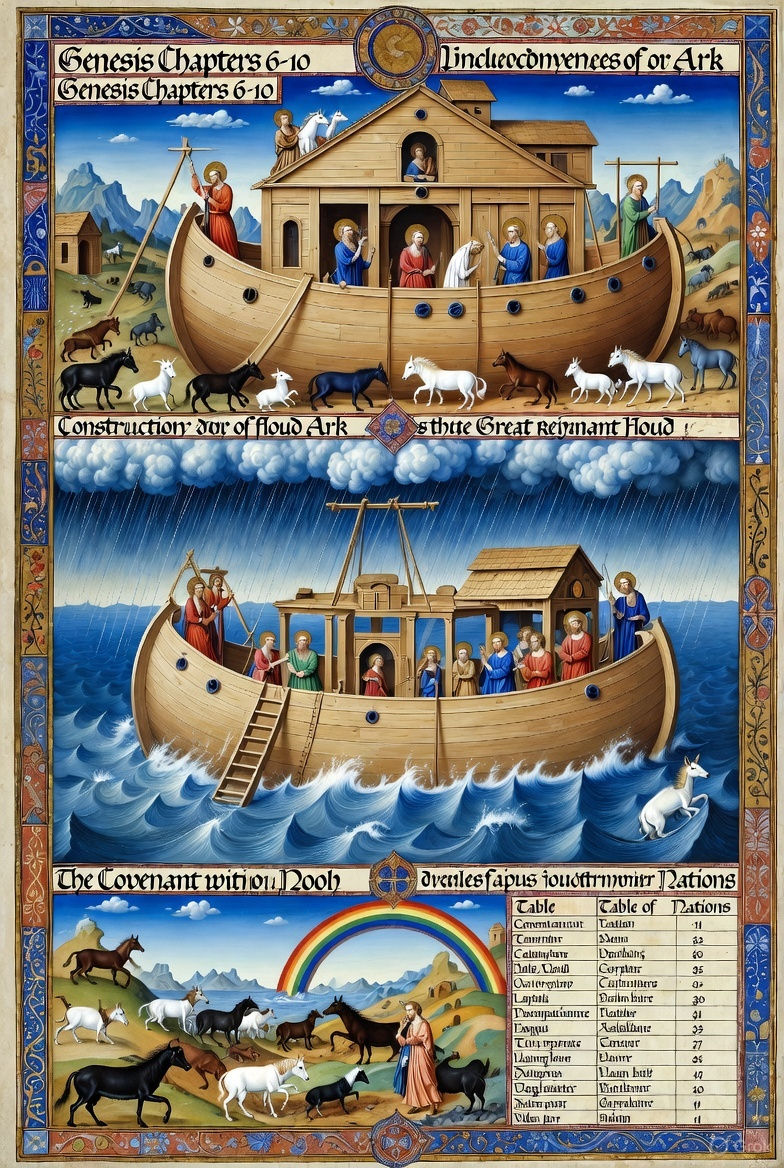
Welcome back to our series on the Book of Genesis. Following our in-depth exploration of Chapters 1-5, where we delved into creation, the Fall, and the early human family, we now turn to Chapters 6-10. These chapters narrate the story of Noah, the Great Flood, the salvation of a remnant, and the establishment of God's covenant with humanity. From a Catholic perspective, this section is rich with themes of divine justice, human corruption, merciful preservation, and the rainbow as a sign of hope—foreshadowing the ultimate covenant in Christ.
As with our previous post, we'll approach this from the Catholic tradition, viewing Genesis as inspired Scripture that uses symbolic and narrative forms to convey profound truths. The Catechism of the Catholic Church (CCC) reminds us that these accounts, while employing figurative language, affirm historical realities like the Flood as a type of baptism and salvation (CCC 1219). Written for the everyday reader—parents, students, or seekers—yet with scholarly depth, we'll reference Church Fathers, papal teachings, and theological insights. No prior expertise needed; just an open heart.
To visualize the ark's assembly and the animals entering, here's a public domain illustration from a 13th-century manuscript by William de Brailes, depicting the animals entering Noah's Ark (Genesis 6:13-7:16). This medieval artwork captures the orderly obedience amid impending judgment. Download it for personal use or sharing—it's in the public domain.

Introduction: The Flood Narrative in Catholic Theology
Genesis 6-10 transitions from primeval history to the patriarchal era, focusing on humanity's deepening sin and God's response. The Flood story isn't unique to the Bible—similar tales appear in Mesopotamian epics like the Epic of Gilgamesh—but Genesis transforms it into a monotheistic drama of judgment and grace. Catholics see the Flood as a historical event with theological layers, symbolizing sin's consequences and God's saving action (CCC 701).
The CCC teaches that the Flood prefigures baptism, which "signifies and actually brings about death to sin and entry into the life of the Most Holy Trinity" (CCC 1213-1216). St. Peter links it to salvation through water (1 Pet 3:20-21). Church Fathers like St. Irenaeus viewed Noah as a type of Christ, saving the faithful remnant.
Historically, composed around the 6th-5th centuries BC, these chapters encouraged exilic Jews, reminding them of God's faithfulness. In our time, amid climate disasters and moral crises, they speak to environmental stewardship, repentance, and hope.
Chapter 6: Wickedness, Grief, and the Call of Noah
Chapter 6 sets the stage for the Flood, depicting humanity's corruption and God's sorrowful decision.
Verses 1-4: The Sons of God and Daughters of Men
"When men began to multiply on the face of the ground, and daughters were born to them, the sons of God saw that the daughters of men were fair; and they took to wife such of them as they chose. Then the Lord said, 'My spirit shall not abide in man for ever, for he is flesh, but his days shall be a hundred and twenty years.' The Nephilim were on the earth in those days, and also afterward, when the sons of God came in to the daughters of men, and they bore children to them. These were the mighty men that were of old, the men of renown" (Gen 6:1-4).
This enigmatic passage has puzzled interpreters. "Sons of God" may refer to angels (fallen, as in Job 1:6) intermarrying with humans, producing giants (Nephilim). Catholics interpret it figuratively, emphasizing sin's spread—perhaps elite abusing power (CCC 57). The 120-year limit caps longevity, signaling judgment.
St. Augustine in City of God (XV, 23) saw it as angelic, but modern views lean toward human lineages (Sethites vs. Cainites).
Verses 5-8: God's Grief and Noah's Favor
"The Lord saw that the wickedness of man was great in the earth, and that every imagination of the thoughts of his heart was only evil continually. And the Lord was sorry that he had made man on the earth, and it grieved him to his heart. So the Lord said, 'I will blot out man whom I have created from the face of the ground, man and beast and creeping things and birds of the air, for I am sorry that I have made them.' But Noah found favor in the eyes of the Lord" (Gen 6:5-8).
God's "regret" anthropomorphically expresses sorrow, not changeability (CCC 271). Wickedness is total—heart-deep (cf. Jer 17:9). Noah's grace highlights election amid corruption.
Verses 9-10: Noah's Righteousness
"These are the generations of Noah. Noah was a righteous man, blameless in his generation; Noah walked with God. And Noah had three sons, Shem, Ham, and Japheth" (Gen 6:9-10).
Noah echoes Enoch (Gen 5:24), a faithful remnant.
Verses 11-13: Corruption of the Earth
"Now the earth was corrupt in God's sight, and the earth was filled with violence. And God saw the earth, and behold, it was corrupt; for all flesh had corrupted their way upon the earth. And God said to Noah, 'I have determined to make an end of all flesh; for the earth is filled with violence through them; behold, I will destroy them with the earth'" (Gen 6:11-13).
Violence (hamas) pollutes creation. Judgment is cosmic, reversing creation.
Verses 14-22: Instructions for the Ark
"Make yourself an ark of gopher wood; make rooms in the ark, and cover it inside and out with pitch. This is how you are to make it: the length of the ark three hundred cubits, its breadth fifty cubits, and its height thirty cubits. Make a roof for the ark, and finish it to a cubit above; and set the door of the ark in its side; make it with lower, second, and third decks. For behold, I will bring a flood of waters upon the earth, to destroy all flesh in which is the breath of life from under heaven; everything that is on the earth shall die. But I will establish my covenant with you; and you shall come into the ark, you, your sons, your wife, and your sons' wives with you. And of every living thing of all flesh, you shall bring two of every sort into the ark, to keep them alive with you; they shall be male and female. Of the birds according to their kinds, and of the animals according to their kinds, of every creeping thing of the ground according to its kind, two of every sort shall come in to you, to keep them alive. Also take with you every sort of food that is eaten, and store it up; and it shall serve as food for you and for them.' Noah did this; he did all that God commanded him" (Gen 6:14-22).
Ark details symbolize salvation: wood prefigures the Cross (St. Ambrose). Covenant first mentioned—promise of preservation.
Catholics see the ark as the Church, saving through waters (CCC 845).
Theological Reflections: Sin grieves God; mercy selects Noah. Applications: In violent times, live righteously.
Chapter 7: The Flood Descends – Judgment and Obedience
Chapter 7 describes the Flood's onset, emphasizing Noah's faithfulness.
Verses 1-5: Entering the Ark
"Then the Lord said to Noah, 'Go into the ark, you and all your household, for I have seen that you are righteous before me in this generation. Take with you seven pairs of all clean animals, the male and his mate; and a pair of the animals that are not clean, the male and his mate; and seven pairs of the birds of the air also, male and female, to keep their kind alive upon the face of all the earth. For in seven days I will send rain upon the earth forty days and forty nights; and every living thing that I have made I will blot out from the face of the ground.' And Noah did all that the Lord had commanded him" (Gen 7:1-5).
Seven clean pairs for sacrifice (post-Flood). Forty days symbolize testing (cf. Lent).
Verses 6-10: Timeline
"Noah was six hundred years old when the flood of waters came upon the earth. And Noah and his sons and his wife and his sons' wives with him went into the ark, to escape the waters of the flood. Of clean animals, and of animals that are not clean, and of birds, and of everything that creeps on the ground, two and two, male and female, went into the ark with Noah, as God had commanded Noah. And after seven days the waters of the flood came upon the earth" (Gen 7:6-10).
Symbolic ages; obedience key.
Verses 11-16: Waters Break
"In the six hundredth year of Noah's life, in the second month, on the seventeenth day of the month, on that day all the fountains of the great deep burst forth, and the windows of the heavens were opened. And rain fell upon the earth forty days and forty nights. On the very same day Noah and his sons, Shem and Ham and Japheth, and Noah's wife and the three wives of his sons with them entered the ark, they and every beast according to its kind, and all the cattle according to their kinds, and every creeping thing that creeps on the earth according to its kind, and every bird according to its kind, every bird of every sort. They went into the ark with Noah, two and two of all flesh in which there was the breath of life. And they that entered, male and female of all flesh, went in as God had commanded him; and the Lord shut him in" (Gen 7:11-16).
Cosmic waters from above/below reverse creation. God shuts door—divine protection.
Verses 17-24: The Deluge
"The flood continued forty days upon the earth; and the waters increased, and bore up the ark, and it rose high above the earth. The waters prevailed and increased greatly upon the earth; and the ark floated on the face of the waters. And the waters prevailed so mightily upon the earth that all the high mountains under the whole heaven were covered; the waters prevailed above the mountains, covering them fifteen cubits deep. And all flesh died that moved upon the earth, birds, cattle, beasts, all swarming creatures that swarm upon the earth, and every man; everything on the dry land in whose nostrils was the breath of life died. He blotted out every living thing that was upon the face of the ground, man and animals and creeping things and birds of the air; they were blotted out from the earth. Only Noah was left, and those that were with him in the ark. And the waters prevailed upon the earth a hundred and fifty days" (Gen 7:17-24).
Total destruction; ark as salvation vessel.
Theological Reflections: Flood as baptismal type (CCC 1219). St. Gregory the Great saw waters as trials purifying the Church.
Applications: Obey amid chaos; trust God's refuge.
Chapter 8: Waters Recede – Renewal and Patience
Chapter 8 shows subsidence, signaling new beginnings.
Verses 1-5: God Remembers Noah
"But God remembered Noah and all the beasts and all the cattle that were with him in the ark. And God made a wind blow over the earth, and the waters subsided; the fountains of the deep and the windows of the heavens were closed, the rain from the heavens was restrained, and the waters receded from the earth continually. At the end of a hundred and fifty days the waters had abated; and in the seventh month, on the seventeenth day of the month, the ark came to rest upon the mountains of Ararat. And the waters continued to abate until the tenth month; in the tenth month, on the first day of the month, the tops of the mountains were seen" (Gen 8:1-5).
"Remembered" means covenantal care. Wind echoes creation (Gen 1:2). Ararat—Armenian region.
Verses 6-12: Raven and Dove
"At the end of forty days Noah opened the window of the ark which he had made, and sent forth a raven; and it went to and fro until the waters were dried up from the earth. Then he sent forth a dove from him, to see if the waters had subsided from the face of the ground; but the dove found no place to set her foot, and she returned to him to the ark, for the waters were still on the face of the whole earth. So he put forth his hand and took her and brought her into the ark with him. He waited another seven days, and again he sent forth the dove out of the ark; and the dove came back to him in the evening, and lo, in her mouth a freshly plucked olive leaf; so Noah knew that the waters had subsided from the earth. Then he waited another seven days, and sent forth the dove; and she did not return to him any more" (Gen 8:6-12).
Birds test habitability. Dove with olive—peace symbol (cf. Holy Spirit).
Verses 13-19: Exiting the Ark
"In the six hundred and first year, in the first month, the first day of the month, the waters were dried from off the earth; and Noah removed the covering of the ark, and looked, and behold, the face of the ground was dry. In the second month, on the twenty-seventh day of the month, the earth was dry. Then God said to Noah, 'Go forth from the ark, you and your wife and your sons and your sons' wives with you. Bring forth with you every living thing that is with you of all flesh—birds and animals and every creeping thing that creeps on the earth—that they may breed abundantly on the earth, and be fruitful and multiply upon the earth.' So Noah went forth, and his sons and his wife and his sons' wives with him. Every beast, every creeping thing, and every bird, everything that moves on the earth, went forth by families out of the ark" (Gen 8:13-19).
New creation echo: "be fruitful."
Verses 20-22: Sacrifice and Promise
"Then Noah built an altar to the Lord, and took of every clean animal and of every clean bird, and offered burnt offerings on the altar. And when the Lord smelled the pleasing odor, the Lord said in his heart, 'I will never again curse the ground because of man, for the imagination of man's heart is evil from his youth; neither will I ever again destroy every living creature as I have done. While the earth remains, seedtime and harvest, cold and heat, summer and winter, day and night shall not cease'" (Gen 8:20-22).
First altar; sacrifice pleases God. Promise of stability despite sin.
Theological Reflections: Renewal post-judgment. Pope Benedict XVI linked to ecology—God's care for creation.
Applications: Patience in trials; gratitude in renewal.
Chapter 9: Covenant, Blessings, and the Sin of Ham
Chapter 9 establishes the Noahic covenant.
Verses 1-7: Blessing and Commandments
"And God blessed Noah and his sons, and said to them, 'Be fruitful and multiply, and fill the earth. The fear of you and the dread of you shall be upon every beast of the earth, and upon every bird of the air, upon everything that creeps on the ground and all the fish of the sea; into your hand they are delivered. Every moving thing that lives shall be food for you; and as I gave you the green plants, I give you everything. Only you shall not eat flesh with its life, that is, its blood. For your lifeblood I will surely require a reckoning; of every beast I will require it and of man; of every man's brother I will require the life of man. Whoever sheds the blood of man, by man shall his blood be shed; for God made man in his own image. And you, be fruitful and multiply, bring forth abundantly on the earth and multiply in it'" (Gen 9:1-7).
Renewed mandate; meat allowed, but blood prohibition (life sacred). Capital punishment affirms human dignity (CCC 2260).
Verses 8-17: The Rainbow Covenant
"Then God said to Noah and to his sons with him, 'Behold, I establish my covenant with you and your descendants after you, and with every living creature that is with you, the birds, the cattle, and every beast of the earth with you, as many as came out of the ark. I establish my covenant with you, that never again shall all flesh be cut off by the waters of a flood, and never again shall there be a flood to destroy the earth.' And God said, 'This is the sign of the covenant which I make between me and you and every living creature that is with you, for all future generations: I set my bow in the cloud, and it shall be a sign of the covenant between me and the earth. When I bring clouds over the earth and the bow is seen in the clouds, I will remember my covenant which is between me and you and every living creature of all flesh; and the waters shall never again become a flood to destroy all flesh. When the bow is in the clouds, I will look upon it and remember the everlasting covenant between God and every living creature of all flesh that is upon the earth.' God said to Noah, 'This is the sign of the covenant which I have established between me and all flesh that is upon the earth'" (Gen 9:8-17).
Universal covenant; rainbow as sign (not weapon, but peace). CCC 71: God's faithfulness.
Verses 18-29: Ham's Sin and Curses
"The sons of Noah who went forth from the ark were Shem, Ham, and Japheth. Ham was the father of Canaan. These three were the sons of Noah; and from these the people of the whole earth were dispersed. Noah was the first tiller of the soil. He planted a vineyard; and he drank of the wine, and became drunk, and lay uncovered in his tent. And Ham, the father of Canaan, saw the nakedness of his father, and told his two brothers outside. Then Shem and Japheth took a garment, laid it upon both their shoulders, and walked backward and covered the nakedness of their father; their faces were turned away, and they did not see their father's nakedness. When Noah awoke from his wine and knew what his youngest son had done to him, he said, 'Cursed be Canaan; a slave of slaves shall he be to his brothers.' He also said, 'Blessed by the Lord my God be Shem; and let Canaan be his slave. God enlarge Japheth, and let him dwell in the tents of Shem; and let Canaan be his slave.' After the flood Noah lived three hundred and fifty years. All the days of Noah were nine hundred and fifty years; and he died" (Gen 9:18-29).
Ham's disrespect (perhaps more); curse on Canaan foreshadows conquest. Blessings on Shem (Semites), Japheth.
Theological Reflections: Covenant universal; sin persists. Applications: Respect dignity; avoid excess.
Chapter 10: Table of Nations – Dispersion and Diversity
Chapter 10 lists descendants, showing humanity's spread.
Verses 1-32: Genealogies
"This is the generations of the sons of Noah, Shem, Ham, and Japheth; sons were born to them after the flood. The sons of Japheth: Gomer, Magog, Madai, Javan, Tubal, Meshech, and Tiras. The sons of Gomer: Ashkenaz, Riphath, and Togarmah. The sons of Javan: Elishah, Tarshish, Kittim, and Dodanim. From these the coastland peoples spread. These are the sons of Japheth in their lands, each with his own language, by their families, in their nations. The sons of Ham: Cush, Egypt, Put, and Canaan. The sons of Cush: Seba, Havilah, Sabtah, Raamah, and Sabteca. The sons of Raamah: Sheba and Dedan. Cush became the father of Nimrod; he was the first on earth to be a mighty man. He was a mighty hunter before the Lord; therefore it is said, 'Like Nimrod a mighty hunter before the Lord.' The beginning of his kingdom was Babel, Erech, and Accad, all of them in the land of Shinar. From that land he went into Assyria, and built Nineveh, Rehoboth-Ir, Calah, and Resen between Nineveh and Calah; that is the great city. Egypt became the father of Ludim, Anamim, Lehabim, Naph-tuhim, Pathrusim, Casluhim (whence came the Philistines), and Caphtorim. Canaan became the father of Sidon his first-born, and Heth, and the Jebusites, the Amorites, the Girgashites, the Hivites, the Arkites, the Sinites, the Arvadites, the Zemarites, and the Hamathites. Afterward the families of the Canaanites spread abroad. And the territory of the Canaanites extended from Sidon, in the direction of Gerar, as far as Gaza, and in the direction of Sodom, Gomorrah, Admah, and Zeboiim, as far as Lasha. These are the sons of Ham, by their families, their languages, their lands, and their nations. To Shem also, the father of all the children of Eber, the elder brother of Japheth, children were born. The sons of Shem: Elam, Asshur, Arpachshad, Lud, and Aram. The sons of Aram: Uz, Hul, Gether, and Mash. Arpachshad became the father of Shelah; and Shelah became the father of Eber. To Eber were born two sons: the name of the one was Peleg, for in his days the earth was divided, and his brother's name was Joktan. Joktan became the father of Almodad, Sheleph, Hazarmaveth, Jerah, Hadoram, Uzal, Diklah, Obal, Abimael, Sheba, Ophir, Havilah, and Jobab; all these were the sons of Joktan. Their territory extended from Mesha in the direction of Sephar to the hill country of the east. These are the sons of Shem, by their families, their languages, their lands, and their nations. These are the families of the sons of Noah, according to their genealogies, in their nations; and from these the nations spread abroad on the earth after the flood" (Gen 10:1-32).
Table of Nations: Japheth (Indo-Europeans), Ham (Africa/Mideast), Shem (Semites). Nimrod as empire-builder.
Theological Reflections: Unity in diversity; pre-Babel. CCC 57: Human family from one stock.
Applications: Embrace cultural diversity; oppose racism.
Lessons from Genesis 6-10 for Today
These chapters depict a world remade through judgment and mercy, culminating in covenant and dispersion. Catholic faith sees them as pointing to Christ, the ultimate ark of salvation.
Themes: Sin's gravity, God's patience, covenantal love.


Comments